
It's after sunset on a Sunday night, and Priya has six browser tabs open: her own homepage and five competitors', side by side, for the positioning review she's presenting to marketing leadership tomorrow. She's been highlighting hero lines in a shared doc for an hour, and the same three phrases keep repeating in different fonts: AI-powered, built for scale, trusted by industry-leading teams.
Priya could rewrite her own headline a fourth time this year. It wouldn't matter. Her whole category has converged on the same six adjectives, and no amount of sharper copy is going to out-argue a claim the buyer knows is marketing. Because the sentence that changes a buyer's mind probably isn’t going to come from Priya's team. It’s going to come from a customer.
Customer proof, a quote, a review, a case study, works because it comes from someone who isn't selling you anything. A buyer is skeptical of a company's claim about itself by default. They aren’t as skeptical about a customer's statement in the same way. Customer proof is the specific, verifiable evidence that a buyer is more likely to trust because it didn't come from your marketing team. It builds trust and shortens sales cycles for a simple reason: unlike a claim your company makes about itself, it comes from someone with no stake in the sale.
Every homepage is arguing the same six adjectives
G2's 2026 "Answer Economy" report found that 51% of B2B software buyers start their research in an AI chatbot more often than Google. What comes back is assembled from everything public about your brand: your G2 reviews, your product pages, your help docs, community threads, third-party round-up articles, and whatever your competitors have seeded into the same conversation. Your approved case study PDF in Highspot or the narrative in your pitch deck isn't in that answer.
Sales reps today meet buyers who are already 60% of the way toward a decision—influenced by evidence that marketing neither chose nor controls. While positioning decks focus on the old question of which vendor best understands the buyer's pain, buyers are now using AI to answer a different one: What do customers, competitors, and the market really think about this solution?
Marketing claims are inherently biased, and buyers know it. An unscripted customer comment is credible precisely because it wasn't manufactured for a campaign. B2B buyer belief hinges on this gap: buyers trust what customers say more than what vendors say about themselves.
Customer love is more convincing than marketing's best argument
At Nectar (a verified Peerbound customer), Holly Higgins, Senior Customer Marketing Manager, put it plainly: "Now sales gets proof from a person instead of a positioning statement." Nectar already valued customer voice before Peerbound. With Peerbound, they shifted from a handful of quotes a team can chase down manually to the scale that comes from listening everywhere a customer already talks.
At Lattice (a verified Peerbound customer), Kerry Wheeler, Director of Product Marketing, saw the same dynamic from the outreach side. Customers who already loved the product were dramatically easier to turn into advocates. Less back-and-forth, fewer ignored requests, higher participation, because belief was already there. You can't manufacture that starting point with a better survey. You can only find the customers who already love you and make it easy for them to share their love publicly.
This is also why a proof gap hurts more than a content gap. A page with a confident claim and nothing backing it asks the reader to just take your word for it. Every major page, every use case, every persona your team targets deserves at least one proof point strong enough to survive a skeptic.
Peerbound turns customer love into a flywheel
This is where Peerbound comes in: it identifies customer love in near real time, gets it in front of marketing without anyone having to chase it, makes approvals easy, and ties every piece of proof it delivers back to a real revenue outcome. Instead of a customer marketing team hunting for advocates one CSM referral at a time, the whole loop runs continuously.
At Crunchtime (a verified Peerbound customer), Thao Littler, Senior Customer Marketing Manager, described Peerbound’s value this way: "Product marketing and development have also been benefitting from the incredible competitive intel we're now able to surface." The same listening that finds a customer story for the website also catches the competitive detail a PMM would otherwise have to go dig up manually before a positioning review.
Peerbound’s proof finder catches advocates a CSM would never think to flag
Peerbound's Find agent listens across calls from 10+ call recording solutions, CRM notes from both Salesforce and Hubspot, and G2 reviews around the clock, so advocacy doesn't depend on a CSM remembering to nominate someone. At Motive (a verified Peerbound customer), a fleet management company serving more than 100,000 customers, that continuous listening expanded advocate discovery well past the accounts CSMs had already flagged, turning up mid-market and lesser-known customer voices the team didn't know it had. At Iterable (a verified Peerbound customer), Jessica Hooper described the same shift in her own words: the integration with her call recordings turned up advocates she didn't even know existed, along with what they were already saying about the product.
Nobody has to remember to ask. The proof is already sitting in a call, a review, a renewal conversation, and the Find agent is the reason it gets picked up instead of forgotten.
Peerbound for Web puts your proof where AI already looks for it
How does customer proof build conviction and buyer confidence? It starts by already sitting wherever the buyer is doing the research, long before sales gets a demo request. According to WBR Research, buyers complete 57 to 70% of their research before they ever speak to sales, which means most of what shapes B2B buyer belief happens somewhere your sales team can't see.
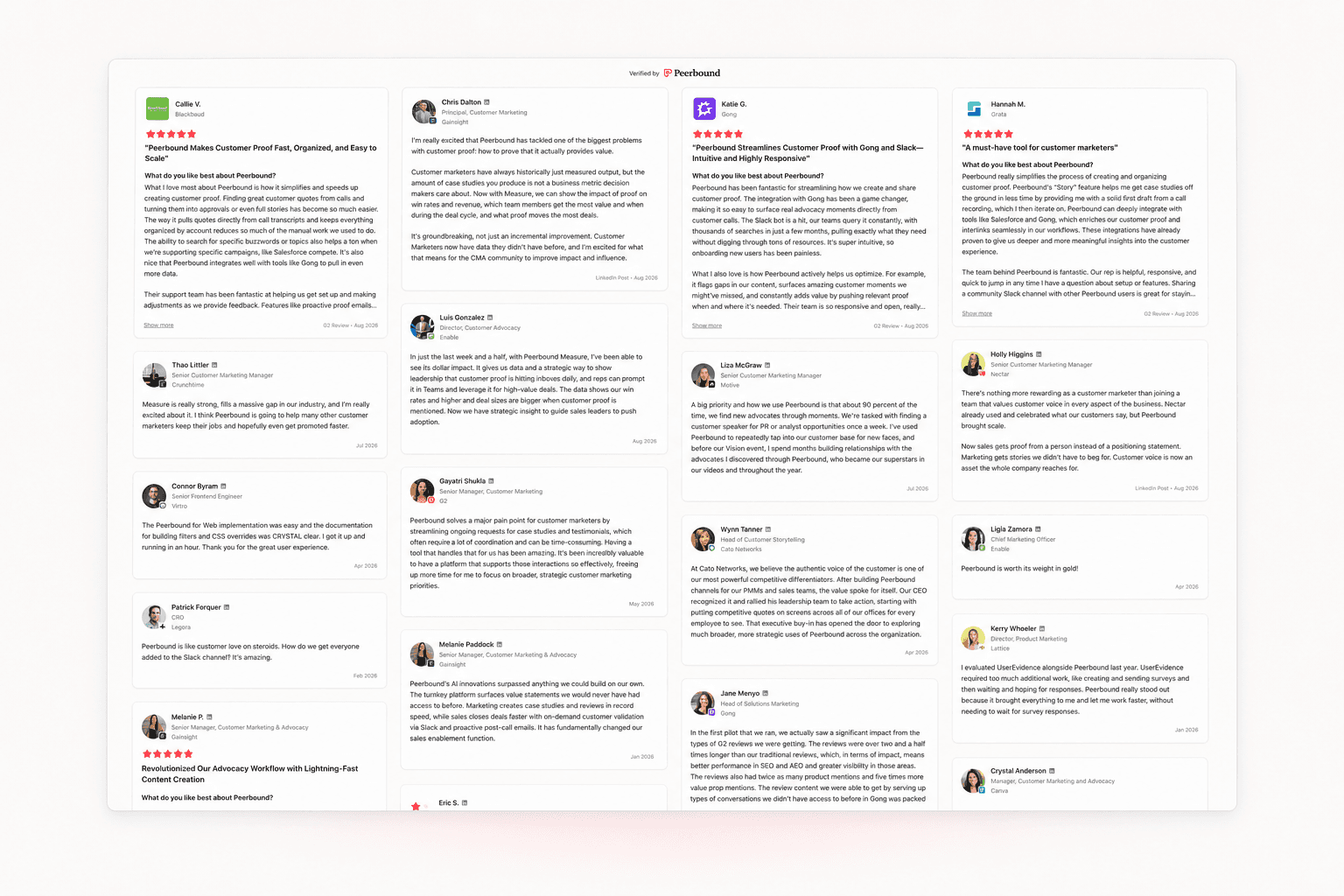
Peerbound for Web closes that gap by publishing your approved quotes, reviews, and stories straight to your website, and keeping them current on its own: new proof gets added as it's approved, and anything you remove drops off automatically. It can also generate a proof page built specifically for AI crawlers to index, so when a prospect asks an AI tool what your customers actually think, your real customer proof is part of the answer instead of whatever your competitors managed to seed first.
Peerbound’s Create agents turn a call into a story or G2 review before the moment goes cold
Manual case study production runs on a familiar cycle: identify a story gap, put together a shortlist of customers, get one to say yes, chase that customer, schedule the interview, draft, revise, wait on sign-off. Peerbound's Create agents shorten that cycle by turning call recordings and transcripts directly into customer stories, quotes, and G2 review drafts, ready for a human to approve rather than write from scratch.
At Tipalti (a verified Peerbound customer), that shift cut customer story turnaround from about two months to two weeks and increased the number of stories published each quarter by 2.5x, while cutting time spent on review drafting and approvals by 70%. At Grata (a verified Peerbound customer), it replaced manual testimonial sourcing entirely and produced five times as many customer stories without adding headcount. And at Gainsight (a verified Peerbound customer), Melanie Paddock described getting a fully structured draft back in about 90 seconds after uploading a recording, a shift that cut case study production time from 90 days to 42, a 53% improvement she credited directly to no longer starting every story from a blank page.
Every draft still goes through human revision and an approval step before it reaches a prospect. The judgment about what ships stays with a person; but that first draft gets much faster. And if proof is a numbers game, getting more first drafts out the door widens the top of your case study funnel, allowing you to get more customer stories into production and thus more customer stories approved.
Measure turns proof from a hunch into a number
Every customer marketer already believes proof works. Few can prove it to the person approving next year's budget. Peerbound's Measure dashboard connects every proof touchpoint from an email send to a call mention back to Salesforce, so you can see which stories showed up in deals that closed and how win rate moved when proof was in the room.

Littler is direct about what that visibility is worth to her role: "Measure is really strong, fills a massive gap in our industry, and I'm really excited about it. I think Peerbound is going to help many other customer marketers keep their jobs and hopefully even get promoted faster."
How does customer proof build conviction and buyer confidence?
It happens the same way every time: a customer says something positive and without coaching, and a buyer who was already skeptical of your own claims believes that sentence instead. Peerbound's job is getting that sentence found, delivered to the right page or the right rep, and counted.
Give your buyers a reason to believe your message
Priya still runs a competitive teardown every quarter. What's changed is what she's looking at. Her homepage still leads with her team's own headline. But right underneath it now sits a customer's plain sentence, found the week it was said and approved days later instead of months, sitting exactly where an AI tool researching her company will find it.
Building B2B buyer belief looks like this in practice: fewer and fewer places left where your site is still asking a buyer to take your word for it. Peerbound is how customer love stops sitting in a call nobody replayed and starts showing up everywhere a buyer is deciding whether to believe you are the solution that they need.
See the full flywheel in action: read how Motive cut content creation time in half while scaling advocacy across more than 100,000 customers.
Customer proof is what makes B2B buyer belief possible: real customer voices carry more conviction than any marketing claim. Here's how Peerbound turns that belief into a flywheel.