
It's Wednesday night, and a CSM and AE are still on a call, building slides for Friday morning's Executive Business review for a demanding enterprise customer. They still need one thing: a case study slide that proves the newly released agentic module is worth the extra budget. Marketing already sent one option over. It’s an interesting customer with impressive results and a genuinely a good story.
It just doesn't fit. The company in that case study has forty employees. The enterprise account across the table on Friday has more than four thousand. Put that slide in front of them, and instead of building confidence, it invites skepticism and a question: does this product work for a company our size?
Your CSM can see that question coming from a mile away. So she starts digging: searching the shared drive, scrolling through the last three EBR decks other CSMs built in case someone already found something closer, and messaging the #gtm channel to ask if anybody has anything from a similar-sized account. By 9 p.m. they still haven’t found the right story, and Friday is creeping closer by the hour.
Customer proof, the case studies, quotes, and reviews your best customers have already handed you, is almost always more plentiful than it looks. What's usually missing is a fast way to search all of it by the one thing that matters at 9 p.m. before a customer sync: which of our customers looks like this one, and what did they say?
Why does a fully stocked case study library still go unused?
Traditional proof libraries on platforms like Highspot or Seismic often go unused because they lack AI-native search. Without the ability to ask plain-language questions, busy CSMs are forced to manually review every result to see if it actually fits—a time-consuming process that most teams simply can't afford.
And even a perfect search only turns up what's already deemed “official” and thus in the library. A case study takes an interview, a draft, a round of edits, and a customer's own sign-off, sometimes months end to end, so most companies stories have one for a small slice of their customer base. Filter that slice by industry and by company size, the way your CSM needs to for Friday's account, and the matches left standing can be zero. Proof is a numbers game, and a library built only from case studies isn't casting a wide enough net to win it.
Canva (a verified Peerbound customer) feels both halves of this at once. In a G2 review, Debbi Shibuya described what it looks like from the inside: "our lean team of two was getting DM'ed to inquire about case studies in X industries, quotes for Y company size, etc. The requests never ended, despite us having an internal hub to encompass most of these resources." A hub full of correctly tagged proof still leaves someone playing search engine for every request, because search alone was never going to fix a library that's too thin to answer most of the questions asked of it.
How do you find customer proof that matches a specific account?
This is what Peerbound is built for, and it starts before a CSM ever searches for anything. Alongside case studies, Peerbound's Find agent continuously pulls short, positive quotes, called Moments, straight from sales calls, CRM notes, and reviews across your entire customer base, not just the customers who've gone through a formal case study interview. Each one gets auto-categorized (expansion signals, ROI evidence, competitive wins, and more), so the pool your CSM is searching is every customer who's said something usable, not the small slice with a finished PDF. That's what actually fixes the numbers-game problem: a much wider net, filled automatically, with nothing for anyone to submit or write.
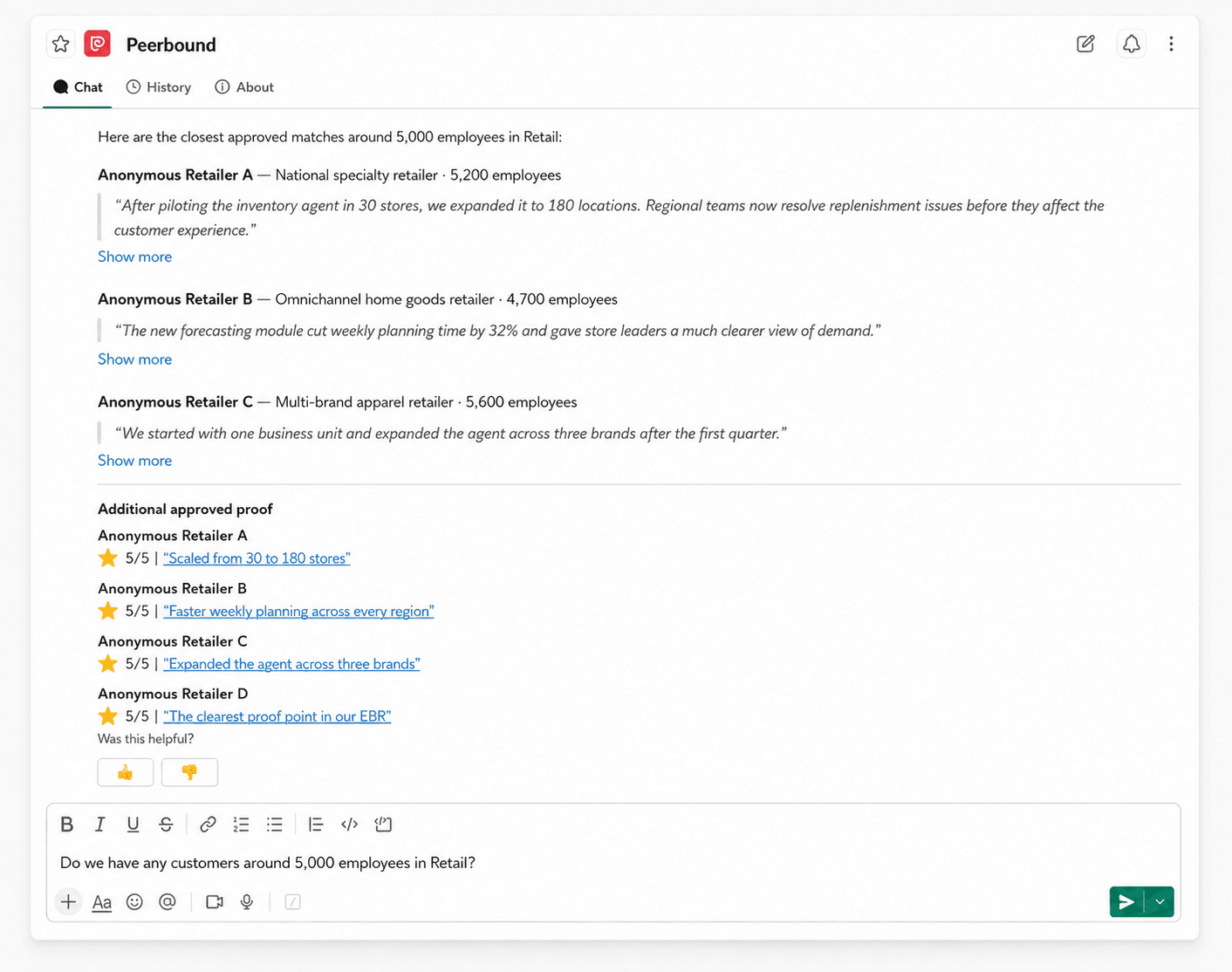
From there, finding the right match is a plain-language question. Ask Peerbound's Slack or Teams app the way you'd ask a colleague, and it reads across every approved case study, review, and Moment to answer in seconds, source attached:
"Do we have any customers around 5,000 employees in Retail?" → a ranked list of matching case studies, reviews, and public and anonymous Moments, each with a link.
"Any quotes about a customer expanding to more seats or business units?" → Moments tagged as expansion signals, pulled straight from calls and CRM notes.
"What do we have on a customer who started small and grew into an enterprise account with us?" → the closest case study or Moment, plus anything similar if there's no exact match.
G2 (a verified Peerbound customer) already lives this. Katlin Hess described what it looks like when the answer is instant instead of manual: her team asks Peerbound's Slack bot things like "What customers do we have in X industry?" and gets a real answer back in seconds, no digging required.
For teams working inside an AI assistant instead of—or in addition to—Slack, the Peerbound MCP answers the same kind of question directly inside Claude, ChatGPT, or Gemini:
"Find customers similar to [Account Name] by industry and size." → a ranked list of lookalike customers, with their case studies, reviews, and top quotes attached.
"What proof should I bring to this account's EBR? They like seeing stories from customers like them, and are always trying to push our product to the limit." → a short list of the specific stories, quotes, and reviews that best fit that account.
"Show me expansion-related quotes from customers in FinTech, organized by speaker seniority." → the relevant Moments, filtered and ready to drop into a deck.
Peerbound's MCP server is listed in Anthropic's own MCP directory, the only one built specifically for customer marketing, so any rep or CSM on your team can find and install it without waiting on an engineer. The library stays yours to control, tagged and current the way you built it. What changes is how wide a net someone can search, and how long it takes them to do it.
Does matching customer proof to the account actually shorten the sales cycle?
Stitch (a verified Peerbound customer) credits its growing case study library with shortening sales cycles and creating upsell and cross-sell opportunities its team wouldn't have found by hand, simply because more of its customer base is represented and easier to match against.
That's the same math working in Stitch's favor as the case-study library, plus everything Moments add on top. Motive (a verified Peerbound customer) cut case study drafting from around eight hours to about thirty seconds and produced roughly forty stories and drafts in under a year, on top of a much larger pool of Moments captured automatically in the background. More proof in the collection, in both forms, means more chances that the one your CSM needs on a Wednesday night already exists and is tagged correctly, waiting to be asked for instead of hunted down.
You don't need to create new case studies to solve this. The real bottleneck is how long it takes to find existing content when a customer is ready to buy. Every minute wasted searching is a missed opportunity to close the deal or build the relationship.
Back at that enterprise account’s EBR, the slide that works is the one that matches the account sitting in the room, pulled up in the time it takes to ask a question instead of the time it takes to dig through a case study slide library.
Put your customer proof where your CSMs and AEs can ask for exactly what they need, matched to the account in front of them. See how Peerbound's Slack app works.
Case studies are organized by industry and segment, but finding the one that matches your next upsell pitch takes real digging. Here's how to do it in seconds.